
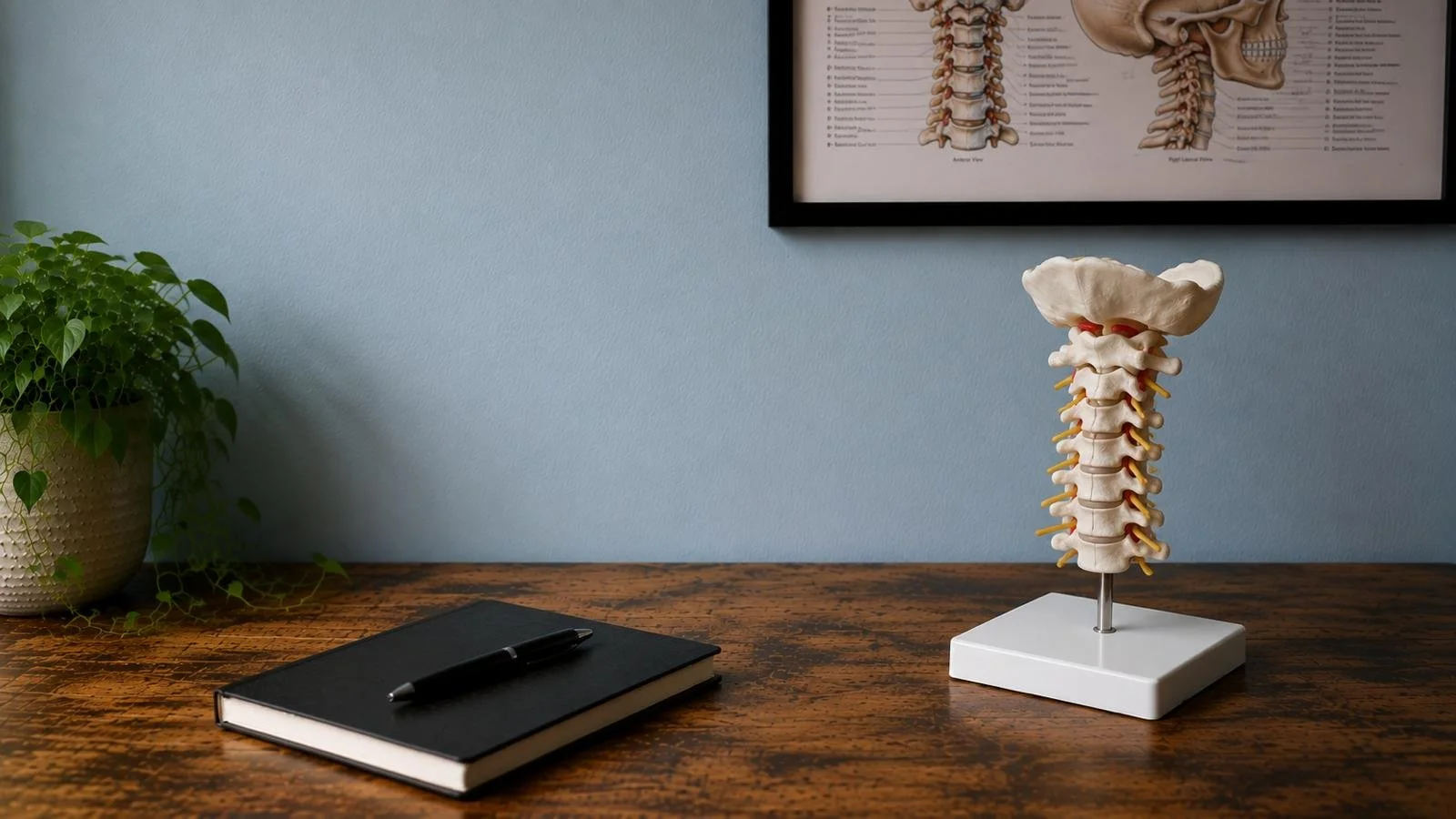
Neck Pain Treatment in Hayes, West London
Whether your neck feels painful, stiff or difficult to move, treatment is tailored to help you get out of pain, restore comfortable movement and get back to doing what matters most.
Neck pain can make everyday activities surprisingly difficult, from turning your head while driving and working comfortably at a desk to sleeping properly or exercising without pain. Symptoms may develop gradually over time or come on suddenly following an awkward movement or injury.
For some people, pain stays around the neck itself, while for others it can spread towards the shoulder blade or into the arm.
Who you'll see
You'll be seen by Arjun Mehra, dual-qualified osteopath and chartered physiotherapist. Your treatment and rehabilitation come from the same person, start to finish, with over a decade of experience helping people reduce pain and stay active.
Appointments usually available within 48 hours, Monday - Thursday.
The Painful Neck
Neck pain can develop suddenly after an awkward movement or build gradually over time.
There are several possible causes of neck pain, and often there isn't one single structure responsible. This is commonly described as mechanical or non-specific neck pain, although the joints, muscles and other structures around the neck may also contribute.

You may notice:
An ache or sharp pain on one side of the neck
Pain when turning your head
Pain looking up or down
Aching across the shoulders or towards the shoulder blade
Pain after sitting or driving for prolonged periods
Difficulty finding a comfortable sleeping position
Mechanical / Non-Specific Neck Pain
Not every episode of neck pain can be traced back to one particular joint, muscle or structure. Mechanical or non-specific neck pain is commonly used when symptoms are influenced by movement, position or activity without one clearly identifiable cause.
Symptoms can range from a general ache or tightness to sharper pain with particular movements.
Muscle Strain & Muscular Neck Pain
An awkward movement, unfamiliar activity, increased training load or prolonged time in one position can sometimes leave the muscles around the neck and shoulders feeling painful, tight or sensitive.
Symptoms may be felt across the neck, upper shoulders or around the shoulder blades and can make movement uncomfortable even without an obvious injury.
Facet Joint Pain
The facet joints are small joints at the back of the neck that help guide movement between the vertebrae. When irritated, pain may be felt more strongly on one side and aggravated by turning the head or looking upwards.
Symptoms can sometimes spread towards the base of the skull, shoulder or shoulder blade without travelling further down the arm.
Cervical Disc Bulges & Herniations
The discs sit between the vertebrae of the neck and help distribute load while allowing the spine to move. A disc bulge or herniation can sometimes contribute to pain felt in the neck, shoulder or shoulder blade.
A disc bulge or herniation doesn't necessarily mean you'll experience symptoms down the arm. However, if a nearby nerve becomes irritated, pain, tingling, numbness or weakness can travel into the arm or hand. We'll cover this in more detail in Pain Into the Arm.
The Stiff Neck
A stiff neck can make everyday movement feel harder than it should. Stiffness may develop gradually over time or follow an episode of neck pain, injury or a period of reduced activity. Reduced movement doesn't necessarily mean there's something damaged or structurally wrong with your neck.
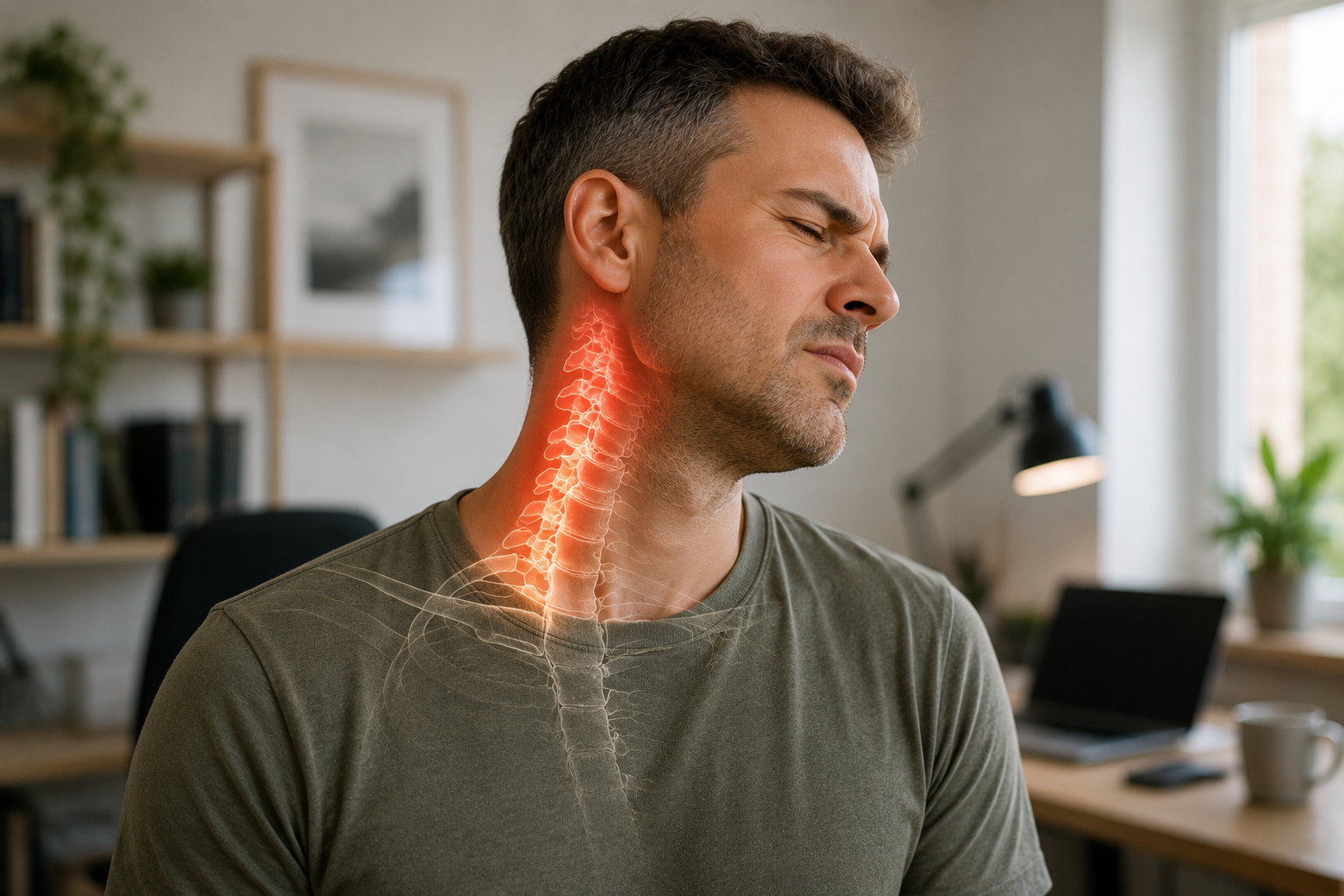
You may notice:
Difficulty turning your head from side to side
Struggling to look over your shoulder when driving
Reduced movement when looking up or down
Stiffness after waking in the morning
Feeling particularly stiff after sitting for long periods
A neck that feels tight or restricted even without significant pain
Muscular Tightness & Joint Stiffness
Stiffness in the neck can involve the muscles, joints or a combination of both. After prolonged time in one position, changes in activity, stress, an awkward night's sleep or a previous episode of neck pain, the neck can sometimes feel tight or restricted. This may be felt through the neck, across the upper shoulders or around the base of the skull.
Cervical Osteoarthritis & Degenerative Changes
As we get older, changes naturally develop within the joints and discs of the neck. You may see terms such as cervical spondylosis, osteoarthritis or degenerative changes on an X-ray or MRI report.
These findings are common and don't automatically mean they're responsible for your symptoms. When they are associated with symptoms, people may experience morning stiffness, stiffness after periods of inactivity and reduced neck movement, which can ease as they get moving.
Pain, Tingling, Numbness & Weakness Into the Arm
Neck problems don't always cause pain in the neck itself. Symptoms can sometimes spread into the shoulder, shoulder blade, arm or hand, sometimes with relatively little neck pain at all.
Pain spreading away from the neck isn't always caused by a nerve. It may be referred pain from structures around the neck, while irritation of a nerve can cause symptoms such as pain, tingling, numbness or weakness into the arm or hand.

You may notice:
Pain travelling from the neck or shoulder into the arm
Pins and needles in the arm, hand or fingers
Numbness or altered sensation
Weakness in the arm or hand
Symptoms that change with neck position
Difficulty gripping, lifting or using the arm normally
Referred Pain From the Neck
Not all pain that spreads into the shoulder, shoulder blade or arm is caused by a nerve. The joints, discs and muscles of the neck can sometimes produce referred pain, where pain is felt away from the area it originates from without a nerve being affected.
Referred pain is commonly felt around the shoulder, shoulder blade or upper arm and doesn't usually cause neurological symptoms such as tingling, numbness or muscle weakness.
Cervical Disc Bulge / Herniation & Arm Symptoms
A disc bulge or herniation can sometimes irritate a nerve in the neck, causing symptoms to travel into the shoulder, arm or hand. Tingling, numbness or weakness may also occur, and some people can have significant arm symptoms with surprisingly little neck pain.
You may also hear terms such as disc protrusion, prolapsed disc or “slipped disc.” Despite the name, a slipped disc hasn't literally slipped out of place, and disc changes are commonly seen on scans in people without symptoms.
Cervical Foraminal Stenosis
The nerves leave the neck through small openings called foramina. Changes involving the joints or discs can sometimes narrow these spaces and irritate a nerve as it leaves the neck.
This may cause pain, tingling, numbness or weakness into the arm or hand, depending on which nerve is affected.
Peripheral Nerve Irritation
Pain, tingling or numbness in the arm or hand doesn't always originate from the neck. Nerves can also become irritated or compressed further along their pathway, including around the shoulder, elbow or wrist.
Conditions such as carpal tunnel syndrome or ulnar nerve irritation can cause symptoms in the hand and fingers that sometimes overlap with those caused by a nerve problem in the neck.
When to Seek Urgent Medical Help
Most pain, tingling or numbness in the arm is related to musculoskeletal or nerve problems. However, seek urgent medical attention if symptoms:
Develop suddenly alongside facial weakness, difficulty speaking, confusion, severe dizziness or loss of coordination, as these can be signs of a stroke.
Occur with chest pain or pressure, shortness of breath, sweating, nausea or feeling generally very unwell, particularly if pain spreads into the arm, jaw, back or shoulder.
Are accompanied by sudden or rapidly worsening weakness, significant loss of coordination, difficulty walking, or new problems with bladder or bowel control.
Whiplash
Whiplash occurs when the head and neck are moved rapidly backwards, forwards or sideways, most commonly during a road traffic accident, although it can also happen during sport, falls or other sudden impacts.
Symptoms don't always appear immediately and may develop over the hours or days following an injury. Neck pain and stiffness are common, sometimes alongside headaches or pain around the shoulders and upper back.
Most people recover well following a whiplash injury, although the time this takes can vary. Gradually restoring comfortable movement and returning to normal activities are often important parts of recovery.
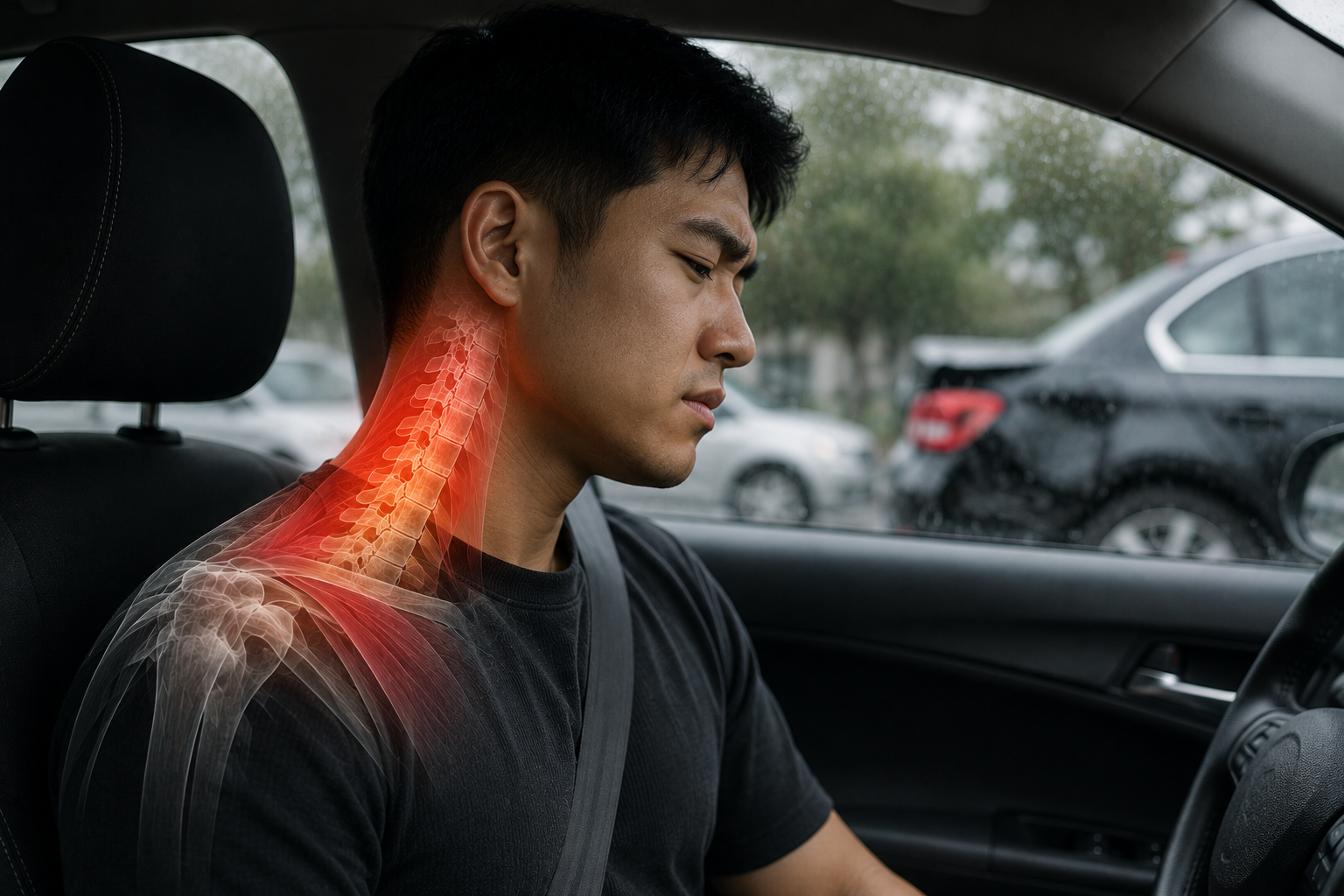
You may notice:
Neck pain or stiffness following an accident or impact
Difficulty turning your head
Pain around the shoulders or upper back
Headaches that developed after the injury
Increased discomfort after sitting or driving
Reduced confidence returning to exercise or normal activities
Headaches & Neck Pain
Headaches and neck pain often occur together. For some people, a headache can start around the neck or base of the skull before spreading towards the back, side or front of the head.
Headaches may also be more noticeable when the neck feels particularly stiff or painful, or when symptoms are influenced by neck movement or prolonged positions.

You may notice:
Headaches that seem to start around the neck or base of the skull
Pain spreading towards the side or front of the head
Headaches alongside neck pain or stiffness
Reduced or painful neck movement
Symptoms that build after prolonged desk or screen work
Tenderness around the upper neck and base of the skull
Cervicogenic Headaches
A cervicogenic headache is a headache where pain originates from structures within the neck but is felt in the head. Symptoms are often one-sided and may begin around the upper neck or base of the skull before travelling forwards.
Neck movement may be restricted or painful, and certain movements or sustained positions can reproduce or aggravate the headache.
Tension-Type Headaches
Tension-type headaches are commonly described as a pressure or tightening sensation around the head, sometimes alongside tenderness or tension through the neck and shoulders.
Although neck and shoulder symptoms can occur alongside tension-type headaches, they aren't necessarily caused by a problem in the neck itself. Other factors such as stress, sleep and prolonged periods of concentration or screen use may also be relevant.
If headaches are your main concern, visit our dedicated Headaches page for more information
Neck Pain During Gym & Sport
Neck pain during training can sometimes be influenced by more than the neck itself. Bracing under a heavy squat, pressing overhead when shoulder or upper-back movement is limited, or repeatedly pushing your head back into the bench during pressing can all increase the demands placed on the neck.
That doesn't necessarily mean you need to stop training. In many cases, activity can be modified while symptoms settle, adjusting your setup, temporarily changing which movements or loads you use, and gradually rebuilding your capacity to tolerate them.
Looking at which exercises bring on your symptoms, when they appear during a session and how your training load has changed can help identify what may be relevant and guide your return to comfortable training.
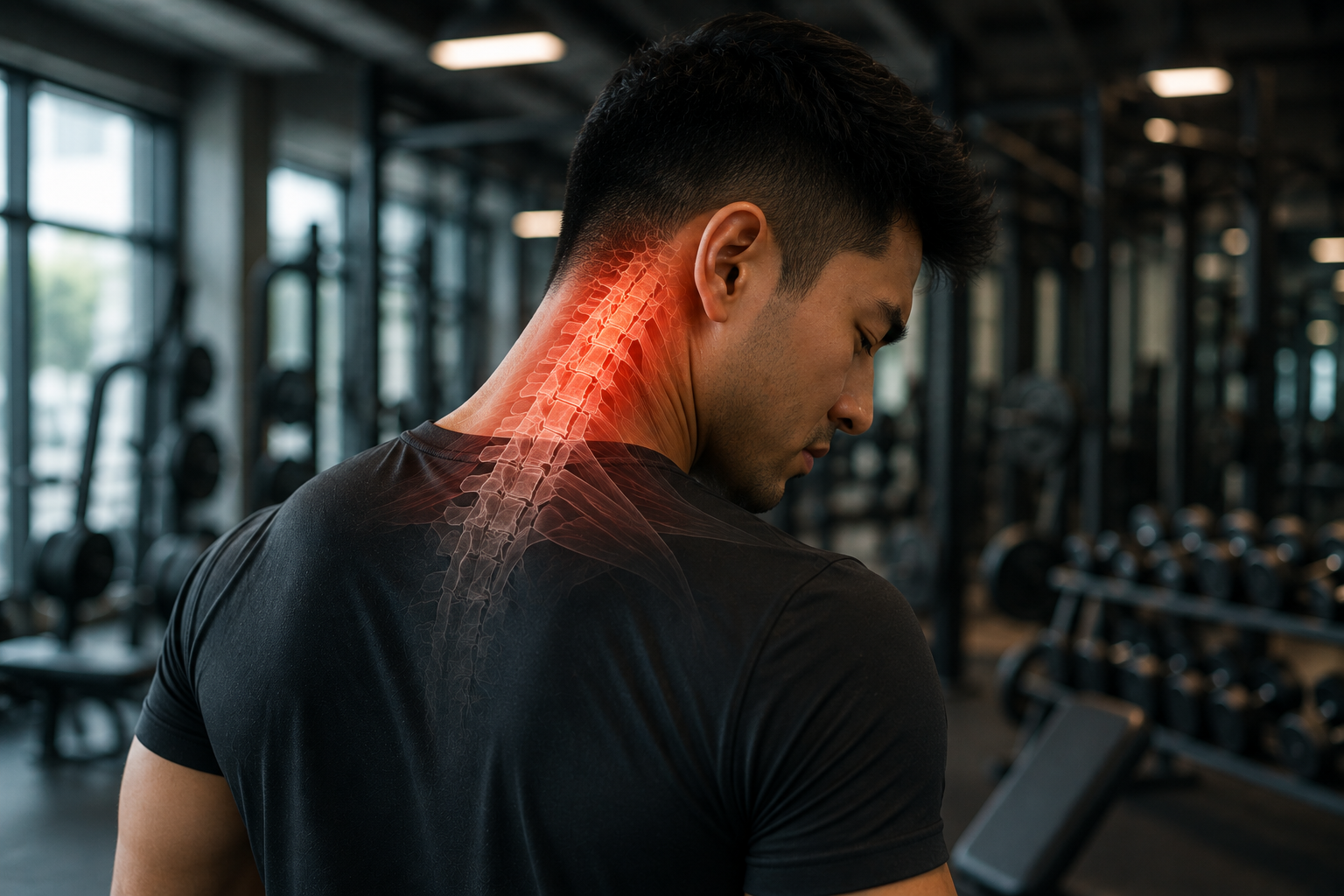
You may notice:
Neck pain during pressing or pulling exercises
Pain or restriction with overhead movements
Tightness or aching across the neck and shoulders after training
Pain as weights or training volume increase
Difficulty turning or extending your neck comfortably
Reduced confidence returning to heavier training or sport
Neck Pain at Work
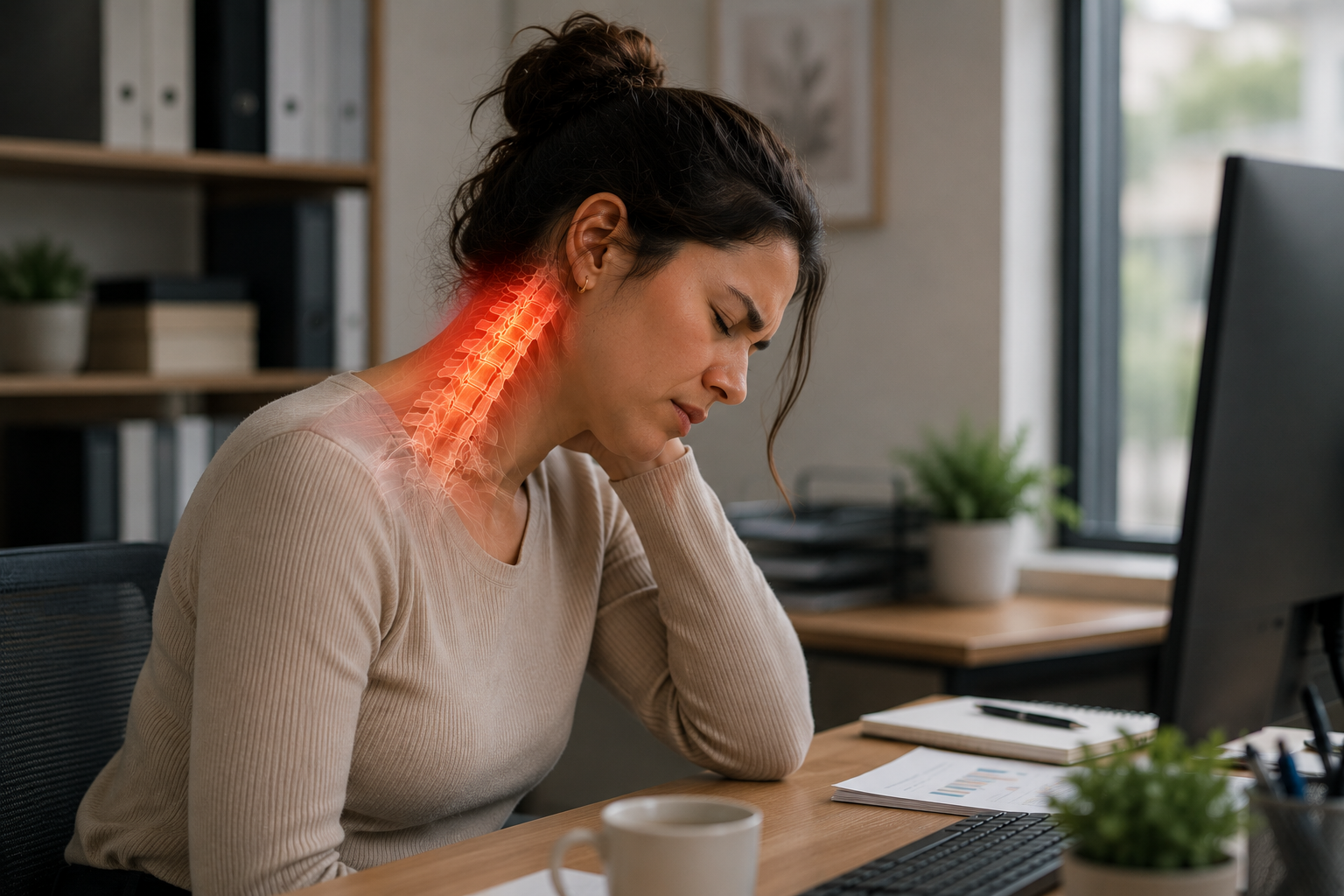
Neck pain can make the working day increasingly uncomfortable, whether you spend hours at a desk, drive for long periods or have a more physically demanding job. Symptoms may build as the day goes on, making it harder to concentrate or move comfortably.
For desk-based work, the problem isn't necessarily one single “bad posture.” Staying in the same position for long periods, limited movement throughout the day, screen setup and the demands of your workload can all influence how your neck and shoulders feel. Changing position and moving regularly can often be more useful than trying to maintain one “perfect” posture.
For more physical jobs, repeated lifting, working overhead, carrying equipment or regularly looking up, down or to one side may become more difficult when symptoms are irritated.
You may notice:
Neck pain or stiffness that builds during the day
Pain after prolonged desk or computer work
Symptoms after driving for longer periods
Tightness or aching across the neck and shoulders
Pain with repeated lifting or overhead work
Symptoms that improve when you're away from work or moving more
After Neck Surgery
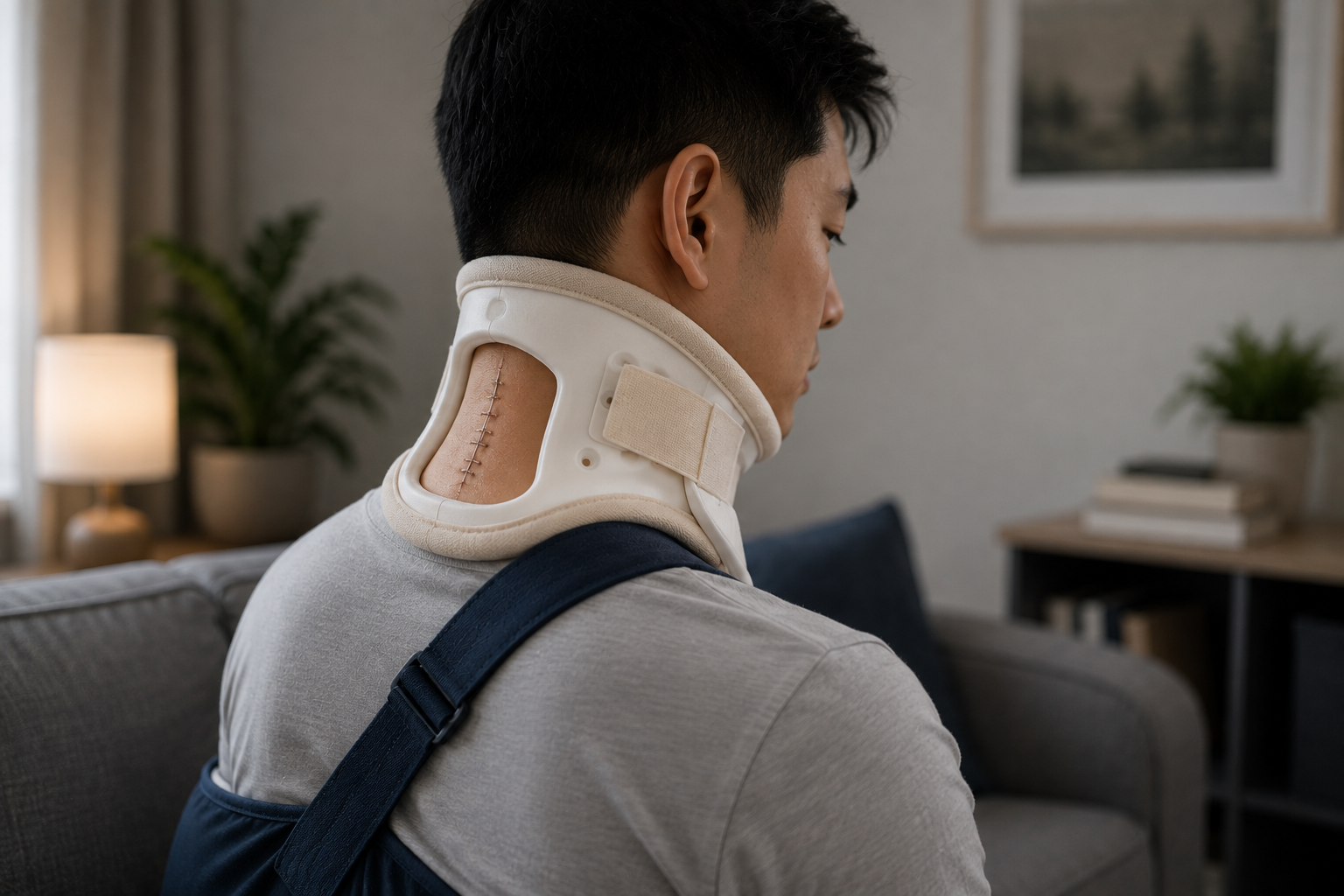
Recovery after neck surgery can take time, and rehabilitation often plays an important role in helping you regain movement, strength and confidence. The right approach will depend on the type of surgery you've had, why it was performed and any guidance or restrictions provided by your surgical team.
In the early stages, everyday activities such as turning your head, looking up or down, sleeping comfortably or returning to work may feel difficult. As recovery progresses, rehabilitation can gradually move towards rebuilding strength and preparing you for the demands of everyday life, work, exercise or sport.
You may benefit from rehabilitation if you're:
Recovering following a cervical fusion
Recovering after cervical disc replacement
Recovering following a cervical discectomy
Recovering after decompression or foraminotomy
Experiencing ongoing stiffness or weakness following surgery
Looking to return to work, the gym, sport or everyday activities
Rehabilitation may involve gradually restoring comfortable movement, rebuilding strength through the neck, shoulders and upper body, and progressively reintroducing activities relevant to your everyday life, work, exercise or sport.
Every operation and recovery is different, so rehabilitation will be adapted to your procedure, stage of recovery and goals, while working within your surgeon's post-operative guidance and any restrictions they've provided.
How We Treat Neck Pain
Treatment may combine hands-on techniques, such as soft tissue work, mobilisation or manipulation where appropriate, with exercises to improve mobility, strength and confidence in your neck.
Your assessment helps guide what you need. We have a broad range of treatment techniques and tools available, allowing treatment to be adapted to you rather than following a set approach. We'll also consider factors such as work, sleep, training and the positions or activities that aggravate your symptoms, shaping treatment and rehabilitation around what you're finding difficult and what you want to get back to.
What Patients Say
Neck FAQs
-
Do I need an MRI or X-ray for neck pain?
Not everyone with neck pain needs a scan. In many cases, symptoms can be understood through your history and physical examination without imaging.
However, scans absolutely can be appropriate in certain situations - particularly following significant trauma, when neurological symptoms are present or progressing, when something more serious is suspected, or when symptoms aren't behaving or improving as expected. If imaging or further medical investigation is needed, this can be discussed as part of your next steps.
-
Not necessarily. Disc bulges and herniations are relatively common and can sometimes be found on MRI scans in people who have no symptoms at all.
When a cervical disc irritates a nearby nerve, however, it can cause pain, tingling, numbness or weakness into the arm or hand. Most cases can be managed without surgery, although significant or worsening neurological symptoms may require further investigation or specialist input.
-
Yes. Some headaches can originate from structures within the neck and are known as cervicogenic headaches. They may occur alongside neck pain, stiffness or reduced movement and often begin around the upper neck or base of the skull.
However, there are many different causes of headaches, so not every headache associated with neck discomfort is necessarily coming from the neck.
-
For most appropriately assessed patients, neck manipulation is generally considered safe, but like any treatment it isn't completely risk-free. This is why your medical history, symptoms and examination findings are considered before deciding whether manipulation is appropriate.
Neck manipulation is also never an essential part of treatment. Other approaches such as mobilisation, soft tissue treatment, exercise and rehabilitation may be used instead, depending on what you need and what you're comfortable with.
If manipulation is considered appropriate, I'll explain what it involves and discuss the benefits and potential risks with you first. It will only be performed with your consent.
-
Usually, complete rest isn't necessary. Keeping the neck moving comfortably and continuing with normal activities where possible can often be helpful, although you may need to temporarily modify movements or activities that significantly aggravate your symptoms.
-
Most neck pain isn't caused by anything serious. However, urgent medical assessment may be appropriate following significant trauma, or if neck pain is accompanied by new or rapidly worsening weakness, problems with walking or coordination, changes to bladder or bowel control, severe unexplained illness, or other concerning symptoms.
If you're unsure whether your symptoms require medical attention, it's always reasonable to seek advice.
Neck pain can have a number of different causes, and you don't need to know exactly what's wrong before booking. That's what the assessment is for.
Not Sure What's Causing Your Neck Pain?
GET IN TOUCH
Ready to Get Started?
Whether you’re dealing with pain, stiffness, injury, or simply want to move better, we’re here to help. Get in touch and we’ll guide you in the right direction.
☎︎︎ Phone: 0203 773 5310
/ 07983 656 671
✉︎︎ Email: info@jigsawosteopathy.com
⌖︎ Clinic location: 70 Seaton Rd, Hayes, UB3 1NU
➜︎ Directions: View on Google Maps →
◷︎ Opening Hours: By Appointment Only | Monday – Thursday | 9am - 7pm
◎︎ Instagram: @osteo.arj
◉︎ Facebook: Jigsaw Osteopathy Clinic